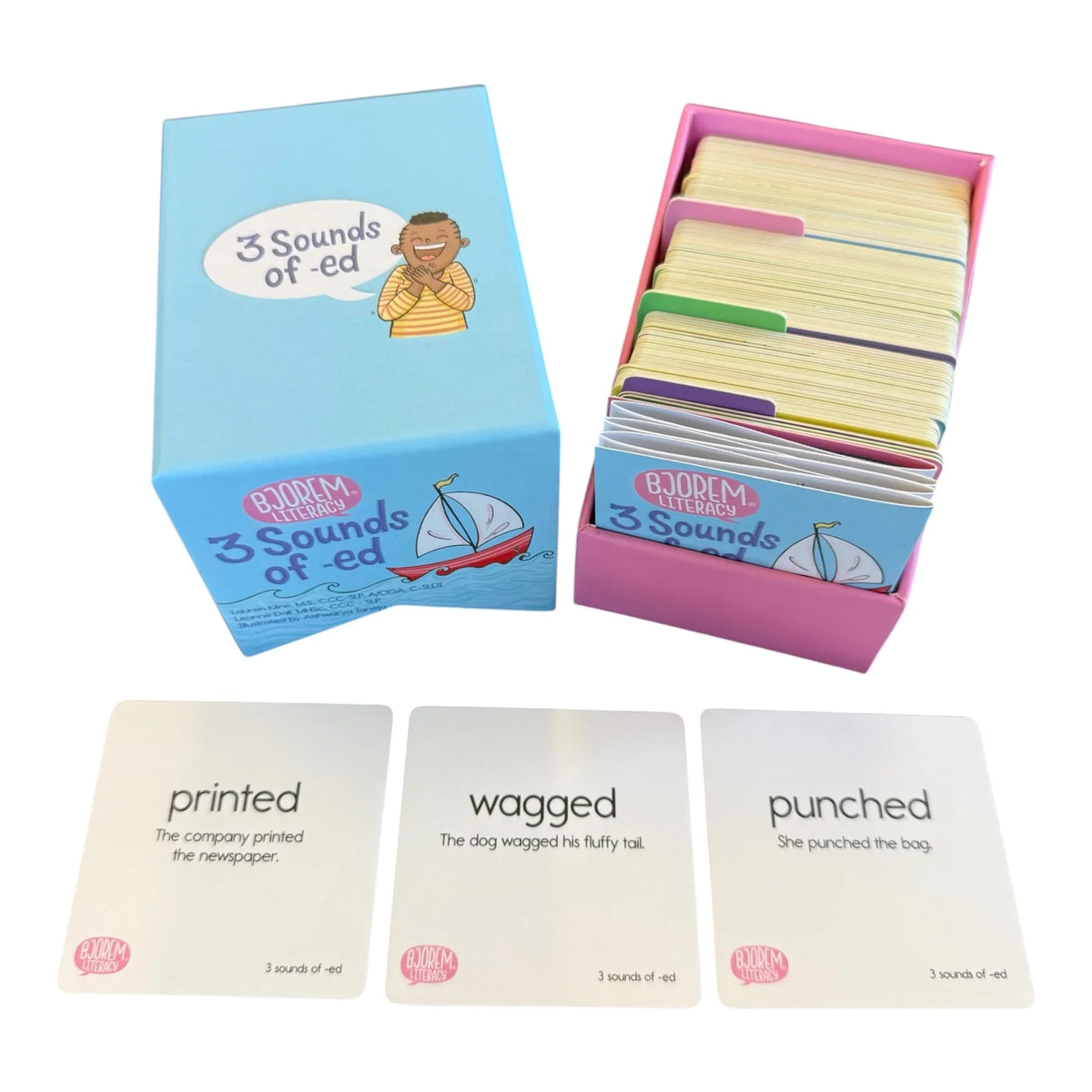
3 Sounds of -ed Word Sort – /t/, /d/, /ɪd/ Past Tense Reading and Spelling Cards
3 Sounds of -ed Word Sort – /t/, /d/, /ɪd/ Past Tense Reading and Spelling Cards
Couldn't load pickup availability
On Order - you can purchase now and it will ship as soon as it lands.
The Bjorem Literacy® 3 Sounds of -ed Word Sortmakes an invisible pattern visible: -ed is one spelling with three pronunciations, and which one you say depends on the last sound of the base word. 112 illustrated cards let students sort, say, read, and spell their way to the rule instead of memorizing it.
Key Features
112 illustrated word cards sorted across all three -ed pronunciations
Three memorable sound anchors — Dripping Faucet /ɪd/, Drum /d/, Tick Tock /t/
Targets 3 great spelling rules — doubling, drop e, and change y to i
Voicing is taught, not assumed — students learn why the base word’s final sound decides which -ed they say
Built-in data collection — pre/post sort probes and a progress path from isolation to words to sentences to spontaneous speech
Minimal pair practice — hopped vs. hoped, so students hear why the spelling rule matters
Aligned with structured literacy and appropriate for Tier 1, 2, or 3
Written by two SLPs and illustrated with inclusive, relatable artwork
Contents
112 illustrated word cards, organized by sound and rule:
/ɪd/ — “Dripping Faucet” (32 cards)
18 no spelling change — acted, needed, planted, wanted
5 doubling rule — chatted, nodded, spotted
9 drop e — faded, graded, voted
/d/ — “Drum” (40 cards)
30 no spelling change — called, played, jogged, smiled
7 change y to i — carried, studied, married
3 ends in y, no change — delayed, enjoyed, stayed
/t/ — “Tick Tock” (40 cards)
28 no spelling change — jumped, walked, watched
9 doubling rule — clapped, stopped, skipped
3 drop e — baked, hoped, liked
Plus:
3 sound anchor cards (Dripping Faucet, Drum, Tick Tock)
3 matching rule cards stating each generalization
Reference insert with the spelling rules, listening, speaking, reading and spelling activities, data collection guidance, and the research base
Want to learn more about this deck and how to use it! Check out our Bjorem Literacy 3 sounds of -ed blog posts
Benefits
Words are stored in memory through orthographic mapping — the process that links sound, letters, and meaning. The suffix -ed is one of the clearest examples in English: it carries past tense meaning while changing its pronunciation based on the final sound of the base word. That makes it a perfect bridge between the speech work you already do and the literacy work your students need.
This deck lets you:
Know which problem you’re looking at. A student who writes jumpt has a spelling problem. A student who says /jʌmpɪd/ has a pronunciation problem. This deck gives you a clear view of both.
Teach voicing explicitly, using the same voiced and voiceless contrasts you already teach in articulation.
Build morphological awareness, which research links to gains in spelling, vocabulary, and reading comprehension.
Generalize to untaught words, because students learn a rule rather than 112 memorized items.
Take real data, with sort tasks that work as pre- and post-probes.
If you already do error analysis on an articulation test, you already have the skills to teach this. The deck gives you the structure.
Speech-language pathologists bridging speech and literacy
Classroom teachers and reading specialists
Structured literacy and dyslexia intervention
Small group instruction, RTI, and literacy centers
Home educators and caregivers